Milvus vs pgvector Which Vector Database Is Right for You
SQLFlash
13 min read

Explore the unique features of Milvus and pgvector.
| Features | Milvus | pgvector |
|---|---|---|
| Type | Dedicated open-source vector database | PostgreSQL extension |
| Performance | Fast searches, supports billions of vectors | Slower for huge searches |
| Scalability | Handles petabyte-scale data | Good for small to mid-size projects |
| Ease of Use | More setup steps for big projects | Simple setup and maintenance |
| Integration | Works with Zilliz Cloud and AI tools | Seamless with PostgreSQL |
| Best For | Large-scale AI and real-time apps | Hybrid projects with relational data |
You want a database that works for you. Milvus can search billions of items fast. This makes it great for AI and big searches. Pgvector is good if you want easy setup. It also works well with other databases. Check the numbers to see how they compare:
| Database | GitHub Stars | Monthly Docker Pulls |
|---|---|---|
| Milvus | ~25 k | ~700 k |
| pgvector | ~4 k | N/A |
Pick Milvus if you need fast searches. It works well with lots of vectors. Milvus is good for big AI projects.
Use pgvector for an easy setup with PostgreSQL. It fits in smoothly. You can use vector search without changing your database.
Milvus is great at performance. It gives quick results with huge datasets. This helps apps that need answers right away.
Pgvector saves money for small projects. You can keep your data together. It adds AI features easily.
Think about your project’s size and how it may grow. Milvus works better for big needs. Pgvector is good for mixed projects with relational data.

Image Source: unsplash
You might wonder how Milvus and pgvector are different. The table below shows what makes each one special. This helps you pick the best database for your needs.
| Feature | Milvus | pgvector |
|---|---|---|
| Type | Dedicated open-source vector database | PostgreSQL extension |
| Performance | Fast searches, supports billions of vectors | Slower for huge searches |
| Scalability | Handles petabyte-scale data | Good for small to mid-size projects |
| Ease of Use | More setup steps for big projects | Simple setup and maintenance |
| Integration | Works with Zilliz Cloud and AI tools | Seamless with PostgreSQL |
| Best For | Large-scale AI and real-time apps | Hybrid projects with relational data |
Milvus lets you work with billions of vectors. You can use it for AI, searching by meaning, and making suggestions. It is good for projects that need quick answers and can get bigger over time. Pgvector gives vector search to PostgreSQL. You can keep vectors with your usual data. This is helpful if you already use PostgreSQL and want to add AI tools.
Pick Milvus if you want fast results and need to grow for big AI projects. You get quick searches and can handle real-time jobs.
Choose pgvector if you want to connect with your current PostgreSQL. You can use vector search with regular SQL questions.
Both Milvus and pgvector help you use vector data. Each one works best for different projects. Milvus is great for big and fast needs. Pgvector is better for smaller jobs or mixing regular and vector data.
Tip: Think about how big your project is and if you want it to grow. If you need to search lots of items fast, Milvus is a good pick. If you want things easy and use your current database, pgvector is a smart choice.
Milvus is a good pick for lots of vector data. Many groups use Milvus for searching by meaning and making suggestions. Developers like Milvus for AI projects. Milvus can handle billions of data points fast. It works well for apps that need quick answers.
Here are some things that make Milvus strong:
| Strength | Description |
|---|---|
| Exceptional Scalability | You can work with huge datasets and keep things running well as your data grows. |
| High-Speed Vector Search | Milvus gives fast results, even with billions of vectors. |
| Resource Optimization | The system uses smart ways to keep things smooth, even when busy. |
| AI Application Integration | Many teams use Milvus for searching by meaning and suggestions in AI projects. |
| Handling Unstructured Datasets | You can use big, messy data and still get quick answers. |
Milvus lets you grow your project and stay fast.
You get quick searches, which helps with AI and machine learning.
The platform uses resources wisely, so it does not slow down.
Lots of developers trust Milvus for big jobs.
If you look at Milvus pg_vector, Milvus can handle much bigger jobs. You can count on it for projects that need to get larger.
Milvus is best for big and fast needs. The setup can be harder if you only want basic vector search or use your old database. For small projects, you might want something easier. Milvus is great when you need to manage billions of vectors and want quick, steady results.
Pgvector lets you add vector search to PostgreSQL. You can use AI features without changing your whole system. Many people like pgvector because it works with what they already know. You keep your data in one place. You also get strong search tools.
Here are some main strengths of pgvector:
| Strengths | Description |
|---|---|
| Integration with PostgreSQL | Pgvector makes PostgreSQL a strong vector platform. You do not need to build something new. |
| Advanced search capabilities | You can do fast and big similarity searches for AI jobs. |
| Enterprise-grade performance | Good indexing helps you get quick and correct results. |
| Security features | Your data stays safe with PostgreSQL’s built-in security. |
| Cost efficiency | You do not need another vector database, so you save time and money. |
Pgvector helps in many real-world cases. You can use it for natural language processing. This means finding the meaning of text or sorting documents.
Milvus and pgvector work at different speeds. Milvus can add data very fast. It also finds answers quickly. Pgvector is slower when you add or search data. Milvus is better if your data gets bigger. You can use Milvus for apps that need answers right away. Pgvector is fine for smaller jobs or if speed is not important.
| System | Inserts/sec | Query Latency |
|---|---|---|
| Milvus | ~120k | ~20 ms |
| pgvector | ~15k | ~120 ms |
Milvus adds more data each second than pgvector.
Milvus gives answers faster than pgvector.
Milvus is good for real-time apps.
Pgvector works for small data or slow jobs.
Tests show how both handle lots of work. Milvus stays fast even with more data. It can answer many questions every second.
| Configuration | QPS | RT(TP99) / ms | RT(TP50) / ms | fail/s |
|---|---|---|---|---|
| Milvus 2.1.0 (Cluster) | 6904 | 59 | 28 | 0 |
| Milvus 2.2.0 (Cluster) | 10248 | 63 | 24 | 0 |
| Milvus 2.1.0 (Standalone) | 4287 | 104 | 76 | 0 |
| Milvus 2.2.0 (Standalone) | 7522 | 127 | 79 | 0 |
| Scale-up (32 CPU cores) | 20281 | 63 | 28 | 0 |
| Scale-out (8 Replicas) | 30655 | 93 | 38 | 0 |
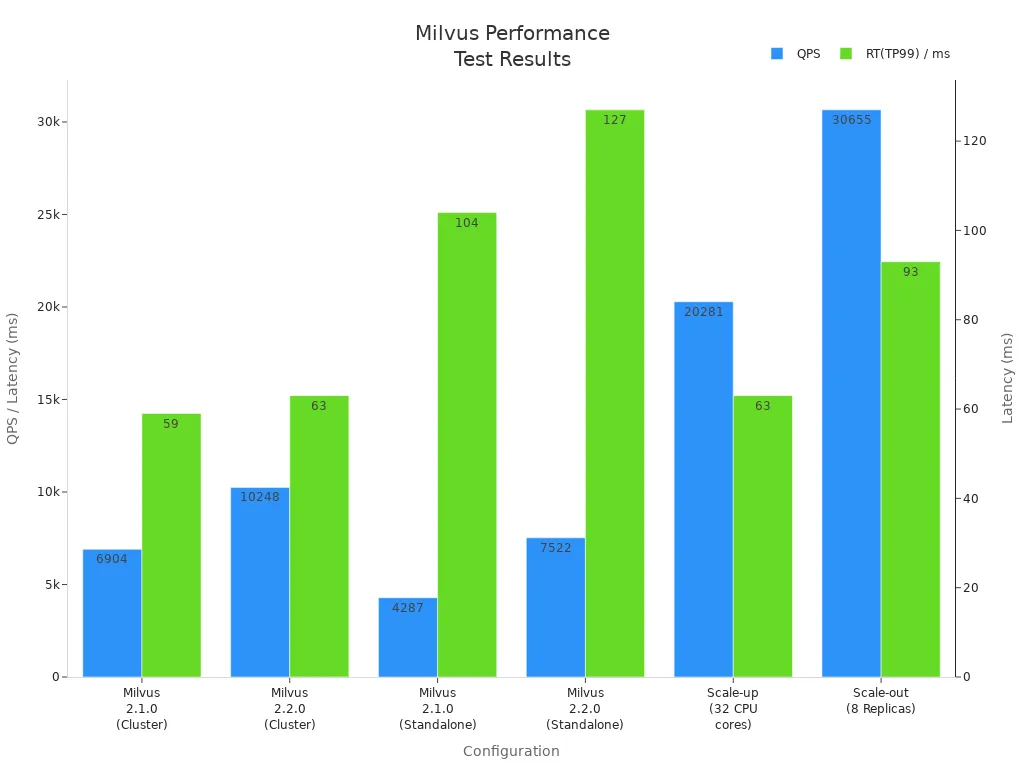
Note: Milvus can answer thousands of questions each second. It stays quick even with lots of data. This helps with AI, search, and suggestions.
Scalability means growing as your data grows. Milvus and pgvector do this in different ways. Milvus is made for big jobs. You can add more computers when you need them. It uses cloud and works with Kubernetes. You can make it bigger or smaller without stopping. Milvus lets many teams use one system. It keeps data safe and running. If something breaks, Milvus can fix itself.
Milvus grows when you need more space.
It works with cloud and Kubernetes.
Many teams can use Milvus at once.
Milvus keeps working even if there are problems.
| Feature | Description |
|---|---|
| Cloud-native architecture | Milvus grows with your data, using cloud features. |
| Stateless design | You can scale easily with Kubernetes or public clouds. |
| Decoupled components | Search, data insertion, and indexing can scale on their own. |
| Distributed architecture | Compute and storage are separate, so you can add more of each as needed. |
| High availability | Quick recovery from failures keeps your service reliable. |
| Fault tolerance | Replicas boost throughput and reliability. |
| Cost-effective storage | Hot/cold storage saves money and keeps performance high. |
| Multi-tenancy support | One cluster can serve many teams without slowing down. |
Pgvector is good for small and medium jobs. You can use it with PostgreSQL you already have. If you need to handle lots of data, Milvus is better.
Tip: If you want your project to get bigger or have lots of users, Milvus is a better choice.
Integration means working with other tools. Pgvector fits into PostgreSQL. You can use SQL and joins like normal. This makes adding vector search easy. Pgvector lets you keep all your data together. You can use PostgreSQL’s safety and backup tools. Many people pick pgvector to add AI to their old databases.
Pgvector keeps vectors with your regular data.
You get PostgreSQL’s safety and backup.
Pgvector is good for adding AI to old databases.
Milvus works with many AI tools. You can use it with Zilliz Cloud. It supports different ways to search and index. Milvus is good for big, fast searches. You can build smart AI apps and use cloud services.
Milvus is best for fast, big searches.
You can connect Milvus to cloud and AI tools.
Remember: Pgvector is easy if you use PostgreSQL now. Milvus is better for big data and AI tools.
Think about your project size, speed, and what you want to connect. Each one is good for different jobs.
It is important to have an easy start with a vector database. Pgvector is simple to set up. You just need PostgreSQL and the pgvector extension. Many people use Railway to make setup faster. This means you do not spend much time on settings. If you know PostgreSQL, pgvector will feel easy to use.
Milvus takes more work to get started. You must set up the database, add SDKs, and connect APIs. This takes longer, but you get more features for big projects. After you finish, you can make a similarity search service very fast. Here is what you need to know:
Pgvector is easy to set up with PostgreSQL.
Railway can help you set up pgvector quickly.
Milvus needs SDKs and APIs for all features.
After setup, Milvus can run big search jobs fast.
It is important to keep your database working well. Pgvector uses PostgreSQL tools, so you can fix problems with what you already know. Milvus has strong tools for managing, but you might need to look online for help.
Here are some common Milvus problems and how to fix them:
| Issue Type | Resolution Steps |
|---|---|
| Connection Errors | Make sure Milvus is running, check the URI, look at firewall rules, try 127.0.0.1 instead of localhost |
| Authentication Issues | Check your token, look at permissions, review what authentication needs |
| Tool Not Found | Restart the app, check server logs, make sure MCP server is there, refresh the settings |
| Getting Help | Go to GitHub Issues, join Discord, or make a new issue |
Both systems can have problems. You might see data not balanced or need to change how data is stored. Pgvector lets you use PostgreSQL tools you already know. Milvus helps you use resources well and grow as your data gets bigger.
You want help if you have trouble. Both Milvus and pgvector have good support. Milvus has guides, tutorials, and busy forums. You can join Discord or look at GitHub for answers. Pgvector has guides for setup and making things better.
Tutorials show how to set up and do more.
Official guides help with installing and managing.
Forums let you ask questions and share ideas.
You can also learn from other places like courses and libraries for searching. Both groups help you fix problems and make your projects better.
If you use artificial intelligence or machine learning, you need a database that works fast with lots of data. Milvus is a good choice for these jobs. It stays quick even when you have billions of vectors. Milvus is great for building big AI apps. It keeps working well if you add more users or data.
Here are some reasons to pick Milvus for AI and ML:
You want to make large AI projects that can grow.
You need your data to be ready all the time.
You want fast results, even as your data gets bigger.
You like using cloud tools and want to scale up easily.
You need help for both CPU and GPU models.
You want strong security and updates from the community.
Milvus lets you search and index your data in many ways. You can use different algorithms for high-dimensional data. This helps your AI models work better. Milvus also keeps your data safe and steady in distributed systems.
Tip: If you want to run your own system, Milvus has a free open-source version. You can use Zilliz Cloud for managed services, which starts at a low hourly price.
If you already use PostgreSQL and want vector search, pgvector is a smart pick. You do not need to change your setup. Pgvector lets you keep vectors with your regular data. You can use all PostgreSQL features like joins, backups, and security.
Pick pgvector if:
You want vector search in your PostgreSQL database.
You work with structured or semi-structured data and need vector embeddings.
You want to keep data and vector search together.
You need SQL for both regular and vector questions.
You want to save time and money by not running another database.
Pgvector works well for many jobs. You can use it for shopping recommendations or finding similar documents. Teams that mix regular and vector data find pgvector helpful.
Note: Pgvector is great for teams that want AI features in their current databases without extra setup.
You might wonder which database is best for your project. The table below shows common uses for Milvus and pgvector in different industries:
| Industry | Use Case | Description |
|---|---|---|
| Healthcare | Medical Image Analysis | Compare image features to help doctors find diseases. |
| Drug Discovery | Find compounds with similar shapes to help make new drugs faster. | |
| E-commerce | Product Discovery | Help shoppers find items like what they already like. |
| Recommendation Engines | Suggest products based on what users prefer, using item embeddings. | |
| Content Management | Categorization and Retrieval | Organize content and make search better using semantic similarity. |
| Content Similarity Analysis | Find duplicates and related content to manage information better. | |
| Customer Support | Intelligent Chatbots | Make chatbots smarter by finding the right answers from knowledge bases. |
| Helpdesk Solutions | Suggest solutions or send tickets faster by looking at past data. |
Use Milvus when you need to search billions of items fast or your project needs to grow quickly. Milvus is best for big AI, real-time search, and high-performance jobs.
Use pgvector when you want vector search in your PostgreSQL database. Pgvector is good for mixing regular and vector data, like shopping suggestions or document searches.
Remember: Think about your project size, how fast you need answers, and if you want to use your current database. Milvus pg_vector both have strong tools, but each works best for different needs.
You have to pick the best database for your project. Milvus is great if you need fast AI and lots of data. Pgvector is good for jobs that mix regular and vector searches. The table below shows how they are different:
| Feature | Milvus | pgvector |
|---|---|---|
| Purpose | High performance, scalability | PostgreSQL integration |
| Use Cases | AI, semantic search | Hybrid, relational + vector |
| Scalability | Handles billions of vectors | Limited by PostgreSQL |
Think about what your project needs before you choose. You can try out demos or read guides to learn more.
| Resource Type | Link |
|---|---|
| Documentation | Milvus Docs |
| Tutorials | Milvus Bootcamp |
Tip: Try both choices to see which one works best for you.
SQLFlash is your AI-powered SQL Optimization Partner.
Based on AI models, we accurately identify SQL performance bottlenecks and optimize query performance, freeing you from the cumbersome SQL tuning process so you can fully focus on developing and implementing business logic.
Join us and experience the power of SQLFlash today!.