

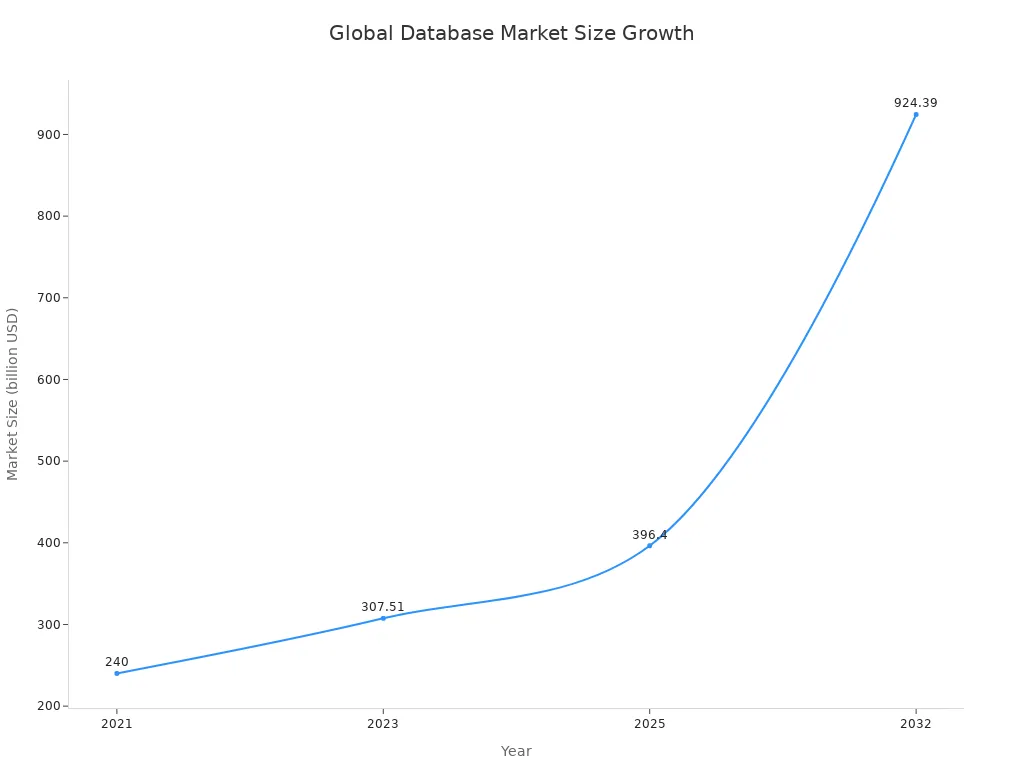
You see big changes in the Database Industry for 2025. Cloud-native, AI-native, and serverless designs now shape how you store and use data. Teams face more challenges with speed and security. The market grows fast, reaching $396.4 billion in 2025.
| Year | Market Size (in billion USD) | CAGR (%) |
|---|---|---|
| 2021 | 240 | N/A |
| 2023 | 307.51 | N/A |
| 2025 | 396.4 | N/A |
| 2032 | 924.39 | 13.0 |
You work with top platforms like Oracle, PostgreSQL, Snowflake, Databricks, and Apache Hive. Your role keeps evolving, so you need to keep learning and adapting.
Key Takeaways
Cloud-native and DBaaS platforms are growing fast. They help save money and give more choices. You do not need to buy physical servers with them.
AI-native databases make storing and finding data better. They help with hard jobs like recommendations and machine learning.
Real-time analytics and edge computing process data right away. This helps people make quick choices and get better results.
PostgreSQL is becoming more popular with developers. It is flexible and has a strong community. Many people use it for new applications.
Learning all the time is important in the changing database industry. Learn skills like Python, SQL, and AI to stay ahead.
Database Industry Trends 2025

Image Source: pexels
Cloud-Native and DBaaS Growth
Cloud-native databases and DBaaS are changing how you handle data. Companies pick these platforms because they are fast and flexible. You can add or remove resources easily. You do not need to buy new machines. More businesses move their data to the cloud, so the Database Industry gets bigger.
The cloud database and DBaaS market was about $19.95 billion in 2024.
Experts think this market will be $23.05 billion in 2025.
By 2035, the market might reach $111.34 billion, with a CAGR of 17.02% from 2025 to 2035.
You save money and set things up faster. You do not have to fix or look after servers. Many companies use DBaaS for jobs that change a lot. This trend lets you spend more time on your data and goals.
Tip: You can begin with a small cloud-native database and grow when you need more. This way, you save time and money.
AI-Native and Serverless Architectures
AI-native databases are getting more popular in the Database Industry. These databases help you store and search data using vectors and embeddings. You use these tools for things like recommendations and finding similar items. Old databases now add AI features, so you can use them for new tasks.
AI-native databases let you store vectors and use semantic queries.
You use these databases for machine learning jobs.
Serverless designs let you grow or shrink your database automatically and pay only for what you use.
You do not have to take care of servers with serverless databases. The system does the work for you.
Amazon Aurora Serverless v2 and PlanetScale are top picks in 2025.
Serverless databases are good for startups and SaaS companies. You build your app and do not worry about servers. This change in the Database Industry makes your job easier and faster.
Note: Serverless databases help you deal with busy times without extra costs or manual work.
Real-Time Analytics and Edge Computing
Real-time analytics and edge computing are changing how you use data. You can work with information right away. This helps you make quick choices and act fast. The Database Industry now has new tools for these needs.
Edge computing lets you study data close to where it is made. This means less waiting and better speed. Stores, factories, and hospitals use real-time analytics to check stock, watch machines, and help patients.
Real-time analytics show you trends and patterns right away.
Edge computing lets you process data near users and devices.
You use both to get faster answers and better results.
These trends help you stay ahead. You can change your plans as soon as things happen.
Callout: Real-time analytics and edge computing let you use data the moment it arrives.
Leading Database Platforms
Top Relational DBMSs
In 2025, you have many choices for relational database management systems. These systems let you keep and organize data in tables. The most popular ones are:
Oracle
MySQL
Microsoft SQL Server
PostgreSQL
IBM DB2
Big companies use these platforms for important work. Oracle and MySQL are still strong in the market. They give you fast speed and lots of features. PostgreSQL is growing fast because it is open-source and easy to change. More companies now use cloud-native and AI features with these databases. This helps you work with new kinds of data and jobs.
Tip: Pick a relational DBMS that fits your needs for speed, price, and help.
NoSQL and Open-Source Leaders
NoSQL databases are getting more popular in the Database Industry. These platforms help you use data that does not fit in tables. You use them for fast searches, real-time analytics, and big data jobs. Here is a table with the top NoSQL and open-source databases in 2025:
| Database | Type | Strengths | Use Cases | Notable Users |
|---|---|---|---|---|
| MongoDB | Document-oriented | Schema flexibility, horizontal scalability, powerful querying and indexing | CMS, real-time analytics, e-commerce | eBay, Adobe, Forbes, The New York Times |
| Cassandra | Wide Column Store | Massive scalability, high availability, write-optimized | Real-time analytics, IoT data ingestion | Uber, Netflix, Instagram, Apple, Spotify |
| Redis | Key-Value Store | Blazing-fast performance, in-memory storage, rich data types | Caching, real-time analytics, messaging | Twitter, GitHub, Pinterest, Stack Overflow, Tinder |
| Couchbase | Document + Key-Value | Flexible JSON-based model, integrated caching, high availability | Mobile apps, e-commerce, real-time analytics |
The market size for NoSQL databases grows from $11.69 billion in 2024 to $15.03 billion in 2025. This means more companies trust NoSQL for their data. You use MongoDB when you need flexible data and quick searches. Cassandra is good for jobs with lots of data. Redis helps you keep and find data in memory, so your apps run faster.
Note: NoSQL databases help you grow your apps and use new types of data.
PostgreSQL’s Dominance
PostgreSQL is becoming a top pick in the Database Industry. More developers and companies use PostgreSQL each year. In 2025, 55.6% of developers say they use PostgreSQL. This is more than last year. PostgreSQL has 16.85% of the relational database market. It is the second most used open-source database after MySQL. About 11.9% of big companies use PostgreSQL for their data.
| Year | Percentage of Developers Using PostgreSQL |
|---|---|
| 2024 | 48.7% |
| 2025 | 55.6% |
PostgreSQL gives you many tools. You can do hard searches, use different data types, and search text easily. You can add new tools and extensions. This makes PostgreSQL very flexible. More people with lots of experience use PostgreSQL. There are fewer new users, but users with over 10 years of experience are growing. Many users now use AI tools with PostgreSQL.
New users with less than 1 year of experience drop to 4.1%.
Users with 1-2 years of experience fall to 8.4%.
Users with 15+ years of experience rise to 21%.
55.3% of users report using AI tools with PostgreSQL.
PostgreSQL is number four in global popularity in 2025. You see it used for web apps, analytics, and cloud services. You pick PostgreSQL because it has a strong community and supports new technology.
Callout: PostgreSQL lets you build modern apps with advanced features and strong support.
Impact on Business and Roles
Evolving Professional Skills
You see that new skills are now important in the database industry. You need to know programming languages like Python and SQL for data work. Companies want you to learn about AI and machine learning because these tools help with business jobs. You must also use cloud platforms like AWS, Azure, and Google Cloud. These platforms help you handle big sets of data and make things that can grow. Good data visualization and talking skills help you explain hard ideas to others. The industry now cares more about real skills than college degrees. People from many backgrounds can join and do well.
Tip: Try to learn skills you can use at work. You can stand out by showing what you can do, not just what you learned in school.
Learn Python and SQL for working with data.
Get experience with AI and machine learning.
Use cloud computing platforms for large projects.
Practice showing data and talking clearly.
Build skills by doing real projects.
Business Strategy Shifts
You notice that businesses change how they work to use data better. Companies try to get better at using data so they can make smart choices. Platform engineering helps make better apps, even ones that use data. Data contracts are now important for following rules like GDPR and CCPA. Data governance keeps companies safe and helps them try new things. AI-driven solutions start to do hard jobs, not just make content.
Companies work on getting better with data.
Platform engineering helps build better apps.
Data contracts help companies follow rules.
Data governance lets companies try new ideas.
AI-driven solutions fix hard problems.
Callout: You can help your company by learning new rules and using data to help it grow.
Case Studies of Adaptation
You see real changes when companies use new database technology. For example, one company cut review time for agreements from three hours to less than ten seconds. Staff hours went down from 360,000 to under 2,000 each year. Accuracy in finding data attributes got better, from 94% to 99%. Loan-servicing mistakes dropped by 27%.
| KPI | Pre-AI | Post-AI | Change |
|---|---|---|---|
| Review time / agreement | 3 hours | < 10 sec | -99.9% |
| Annual staff hours | 360,000 | < 2,000 | –358k |
| Attribute-extraction accuracy | 94% | 99% | +5 pp |
| Loan-servicing errors | Baseline | -27% | -27% |
The company saved about $32 million each year. They spent $25 million at first and made their money back in ten months. In three years, their return rate was over 120%. You can see that using new database tools brings big rewards.
Database Industry Challenges
Security and Data Privacy
Every year, new threats appear in database security. In 2025, cyberattacks get smarter. Hackers use phishing and ransomware to steal your data. Zero-day vulnerabilities let hackers attack before you fix problems. Deepfake and fake media make it hard to know what is real. More connected devices give hackers more ways to get in. You need AI-driven defense to find threats fast.
Smart cyberattacks try to hide from you.
Phishing and ransomware tricks are harder to spot.
Zero-day attacks happen more and put systems at risk.
Deepfakes make it tough to trust information.
IoT devices give hackers more places to attack.
AI-powered monitoring is now very important.
| Statistic | Value | Year |
|---|---|---|
| Global average cost of a data breach | $4.44 million | 2025 |
| Average cost in the U.S. | $10.22 million | 2025 |
| Organizations fully recovered | 35% | 2025 |
| Companies increasing security spending | 49% | 2025 |
You must keep private data safe and follow rules like GDPR and HIPAA. Manual controls and old security do not work well now. You need flexible tools that change quickly.
Tip: Use AI tools and update often to protect your data.
Alert Fatigue and System Complexity
You get lots of alerts every day. In 2025, 28% of teams miss important alerts because they feel tired. Over half of alerts are not real or repeat too much. Complex systems make it hard to find real problems. You might miss big warnings.
Too many alerts make you tired.
Complicated systems cause missed alerts.
False and repeat alerts waste your time.
You can beat alert fatigue by using automation and smart tools. Automation lets you focus on real problems and make fewer mistakes.
Callout: Use automation and clear dashboards to lower alert noise.
Compliance and Skills Gap
You must follow strict rules to keep data safe. Rules change a lot, so you must keep learning. Many teams do not have enough skills. You need people who know new tech and laws. Companies use special training and hire different people to fix this. Schools help students learn the right skills. AI and analytics help you find and fix skill gaps faster.
| Approach | Description |
|---|---|
| Workforce development | Industry-specific training programs |
| Reskilling and upskilling | Ongoing employee learning |
| Inclusive hiring | Diverse talent pools |
| School partnerships | Align courses with industry needs |
| Tech solutions | AI-driven skill assessment and training |
You stay ahead by learning new things and following new rules.
Note: Keep learning and work with your team to get stronger.
Emerging Technologies and Companies

Image Source: unsplash
Innovative Database Architectures
New database architectures are changing how you use data in 2025. These designs help you fix problems faster and make systems stronger. You can pick different types for your needs. Here is a table with the most creative architectures:
| Architecture Type | Description |
|---|---|
| HTAP Systems | Combines transactional and analytical jobs at the same time. You do not need old ETL steps. |
| Cloud-native Databases | Uses serverless scaling and distributed SQL. You handle relational data with more freedom. |
| NewSQL Databases | Mixes NoSQL scaling with ACID rules. You get both strong rules and speed. |
| Data Mesh | Shares data ownership and control. You move away from old, central systems. |
HTAP systems give you quick answers from your data. Cloud-native databases let your apps grow without server worries. NewSQL gives you strong rules and fast speed. Data mesh lets teams own and manage their data.
Tip: Test different architectures to see what fits your company best.
Promising Startups
Many startups bring new ideas to the database industry. These companies use new tech to solve tough problems. Some make data easier to use. Others help keep data safe or work with AI. Startups build tools for real-time analytics and edge computing. They help you get answers faster and use data in new ways.
Startups make databases that grow easily.
Some offer AI-powered search and analysis.
Others build tools for sharing data in new ways.
Many focus on keeping data safe and private.
You can learn from these startups and use their tools to make your work better.
Future Outlook
Big changes will happen in the database industry after 2025. Companies want to use data for quick decisions and adapt fast. AI-driven automation will help you manage data faster and make smarter choices. You will see more focus on data governance to keep information safe. New ways to share data will make it easier and safer.
| Trend | Description |
|---|---|
| AI Integration | AI will do tasks and make data analysis better. |
| Data Governance | You will need strong rules to keep data safe. |
| Decentralized Approaches | You will use new ways to share and protect data. |
You will use databases for instant answers.
AI will change how you handle and use data.
Companies using new data methods will do better.
Callout: Get ready for the future by learning about AI, data governance, and new database designs.
You notice cloud-native, AI-native, and serverless databases are changing things. PostgreSQL and NoSQL platforms are very popular now. Security problems and missing skills make your job harder. To keep up, you can:
Use AI-powered analytics to make smarter choices.
Try Data-as-a-Service for simple access and saving money.
Pick multi-cloud plans for more options.
Check data quality and follow good rules.
Automate data analysis so everyone can use it.
You help the future by learning new skills and trying new tools.
Recommended reading
What is SQLFlash?
SQLFlash is your AI-powered SQL Optimization Partner.
Based on AI models, we accurately identify SQL performance bottlenecks and optimize query performance, freeing you from the cumbersome SQL tuning process so you can fully focus on developing and implementing business logic.